
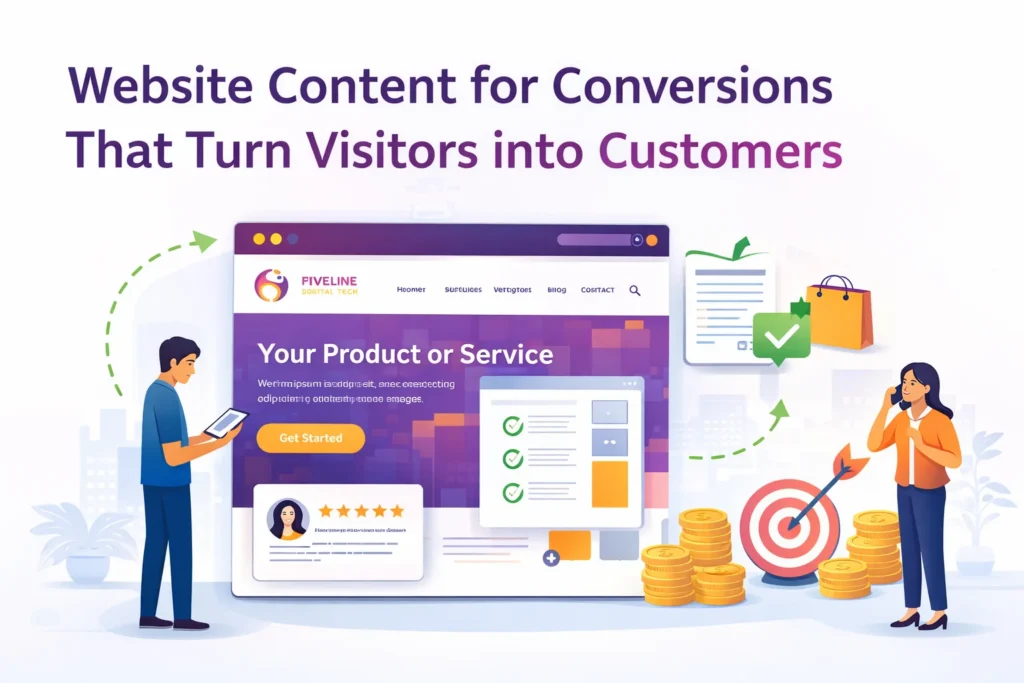
Website content for conversions plays a critical role in deciding whether a visitor stays, trusts your brand, or leaves without taking action. Many websites get traffic but fail to convert because the content does not guide users clearly or address their real needs.
In the Indian market, users compare quickly, read selectively, and expect clarity within seconds. That is why content must be simple, relevant, and action-oriented. At FiveLine Digital Tech, we often see businesses improve results not by redesigning their website, but by rewriting content that speaks directly to their audience.
This article explains how to create website content that builds trust, solves problems, and gently moves visitors toward becoming customers—without sounding salesy or aggressive.
Why Website Content Matters More Than Design
A visually attractive website may grab attention, but content decides conversions.
Good website content:
- Explains what you offer in simple words
- Builds confidence in your business
- Answers user questions instantly
- Guides visitors toward the next step
Poor content creates confusion, even on well-designed websites.
Website Content for Conversions: Core Principles
1. Clarity Comes First
Visitors should understand your business within 5 seconds.
Avoid:
- Complicated sentences
- Technical jargon
- Long paragraphs
Use:
- Clear headlines
- Short sentences
- Everyday language
If users need to “think,” they usually leave.
2. Speak to User Problems, Not Features
Most websites focus on what they do. High-converting websites focus on what users need.
Instead of:
“We provide advanced digital solutions.”
Use:
“We help small businesses get more leads online.”
Problem-focused content feels personal and trustworthy.
How Content Builds Trust on Your Website
Trust is the foundation of conversions.
Key trust-building elements:
- Real testimonials
- Clear contact details
- Simple explanations of services
- Honest pricing or process clarity
Helpful trust signals include:
- “About Us” written in human tone
- FAQs that answer real doubts
- Consistent messaging across pages
When users feel safe, they take action.
Content Structure That Guides Visitors Naturally
1. Strong Headlines That Set Expectations
Each page should have:
- One clear main headline
- Supporting subheadings
- Logical flow from top to bottom
Headlines should promise clarity, not hype.
2. Use Scannable Content Layouts
Indian users often scan before reading fully.
Use:
- Bullet points
- Short paragraphs (2–3 lines)
- White space between sections
This improves readability and time on page.
Calls-to-Action That Feel Natural
A call-to-action (CTA) should guide, not pressure.
Examples of soft CTAs:
- “Learn how it works”
- “Check if this suits your business”
- “Talk to our team”
Avoid aggressive phrases like “Buy Now” unless necessary.
Place CTAs:
- After explaining value
- At the end of sections
- On service pages and blogs
SEO and Conversion Must Work Together
SEO brings traffic. Content converts it.
High-converting SEO content:
- Matches search intent
- Answers questions clearly
- Uses keywords naturally
- Avoids keyword stuffing
Search engines reward helpful content, and users respond to it.
Common Content Mistakes That Reduce Conversions
Avoid these issues:
- Talking only about your company
- Writing for search engines, not users
- Overusing buzzwords
- Missing clear next steps
Fixing these alone can improve conversion rates significantly.
Measuring Content Performance the Right Way
Look beyond traffic numbers.
Track:
- Time spent on page
- Scroll depth
- Contact form submissions
- Clicks on CTAs
Content that converts always shows engagement signals.
Conclusion
Website content for conversions is not about selling harder—it is about communicating better. Clear messaging, user-focused structure, and trust-building elements help visitors feel confident in taking the next step.
When content answers questions, removes doubts, and guides users gently, conversions happen naturally. Businesses that invest in content clarity often see better results than those chasing only traffic.
At FiveLine Digital Tech, we believe content should help first and convert second. When both work together, sustainable growth follows.